

Overview
This course for the Postgraduate Exit Orthopaedic Examination (FRCS) has been meticulously designed to meet the needs of all candidates, at any stage of preparation .
The goal is to provide candidates with the necessary skills and knowledge to excel in the exam.
Our teaching faculty have been handpicked based on their extensive experience in guiding candidates for the FRCS (T&O) exam. They are deeply committed to helping each candidate reach their highest possible level of achievement in the examination.

Target audience
- Candidates preparing for part 2 of FRCS Exam.
- Useful to supplement ISCP portfolio :The structured assessment and feedback can be added to your ISCP portfolio .
Course Aims
- Identify and close knowledge gaps across the Trauma & Orthopaedic curriculum, ensuring focused and effective exam preparation.
- Develop confidence and proficiency in delivering clear, concise, and structured answers under viva examination conditions.
- Experience a broad range of viva questions, clinical scenarios, and examination topics reflecting the scope of modern orthopaedic practice.
- Explore high-yield topics, challenging concepts, and commonly tested areas that frequently appear in postgraduate orthopaedic examinations.
- Gain valuable insight into realistic exam scenarios and examiner expectations.
- Learn proven revision techniques, study strategies, and approaches to maximise examination performance.
The course will help candidates to:
- Develop the structure, content, and presentation of high-scoring viva responses.
- Enhance verbal and non-verbal communication skills essential for viva and oral examinations.
- Identify individual strengths and areas for improvement across the knowledge, clinical reasoning, and professional skills assessed in the FRCS examination.
- Understand how examiners assess performance and learn practical strategies to maximise marks.
- Master the effective use of key terminology, phrases, and communication techniques expected in successful viva candidates.
- Receive detailed, personalised feedback after every station, highlighting strengths, areas for development, and specific actions to improve future performance.
- Build a systematic, examiner-focused approach to clinical reasoning, decision-making, and patient management.
- Track progress over time and monitor improvement across different topics and assessment domains.
Structure of the Course
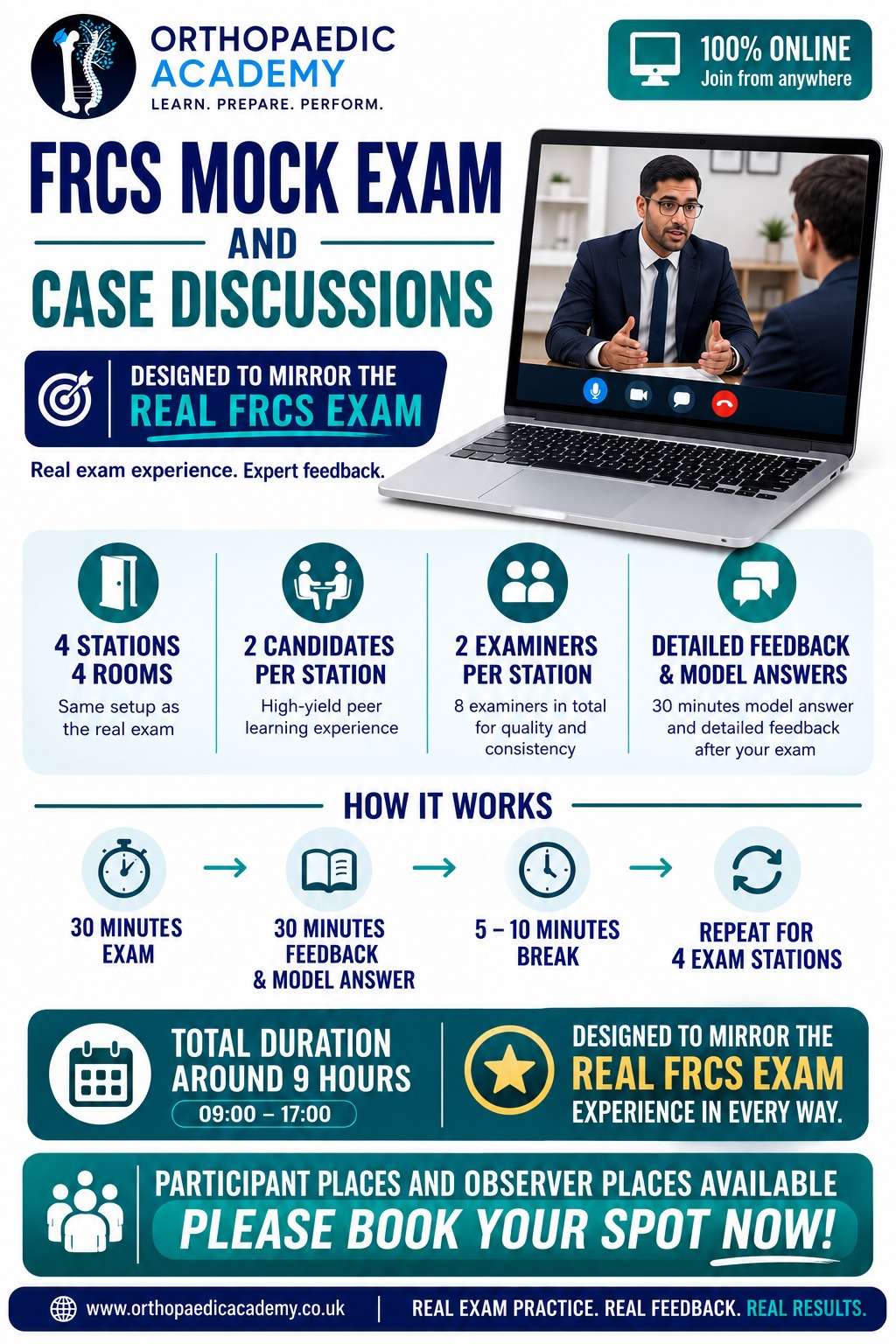
Candidates will work through a series of carefully selected viva scenarios and examination-style questions under the guidance of our experienced teaching faculty.
All faculty members are highly experienced in FRCS examination preparation, actively involved in FRCS teaching programmes, and familiar with the standards, expectations, and marking criteria used in the examination.
Each station is staffed by at least two experienced faculty members, providing an exceptional teaching environment with a 1:1 candidate-to-faculty ratio.
To maximise learning opportunities and individual participation, candidates are organised into small groups of just two participants and rotate through multiple examination stations.
Ample time is allocated for discussion, questions, and personalised feedback, ensuring that every candidate receives targeted support throughout the course.
Each scenario is followed by a detailed discussion and analysis, focusing on clinical reasoning, examination technique, key learning points, and examiner expectations. Faculty members will clarify important concepts, identify areas for improvement, and help candidates develop a structured approach to answering viva questions.
Marking Criteria
The outcome grade in the FRCS exam is based on:
- Methodical approach to your answer
- Clear decision making
- Ability to proceed with minimal prompting
- Familiarity with relevant supporting literature
Time Table
- Basic Sciences
- Paediatric Orthopaedics
- Hands
- Adult Pathology
- Trauma
- Q & A , Conclusions and close


Nicola Evans
FRCS (Tr&Orth)
Morecambe Hospital Senior Ortho Academy Educator Lead FRCS Mentor

Firas Arnaout
FRCS (Tr&Orth)
Consultant Orthopaedic Surgeon Founding Director of Orthopaedic Academy