

Open Distal Both-Bone Forearm Fracture-dislocation with Wrist-Spanning External Fixation Following Hoverboard Fall
Case Details
Relevant Clinical History
Chief Complaint
Pain, deformity, and open wound with exposed bone to the right wrist and distal forearm following a fall from a hoverboard.
History of Present Illness
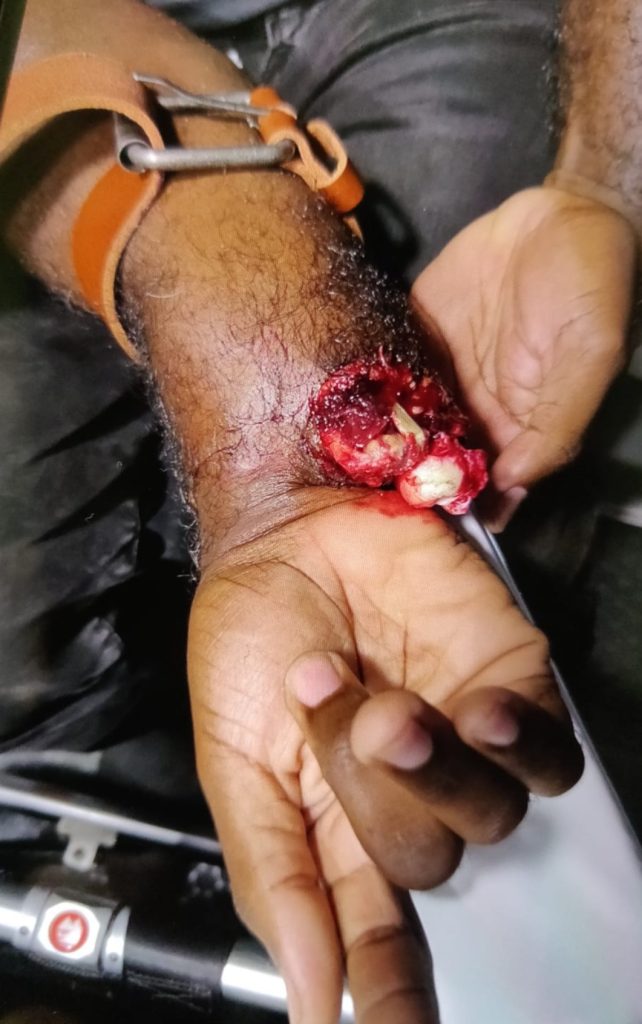
46-year-old male with no significant past medical history, presented to the emergency department on the evening of 26 August 2022 following a fall backwards while using a hoverboard. During the fall, the patient sustained significant trauma to the right upper extremity.
On presentation, the patient complained of severe pain, visible deformity, and an open wound involving the right wrist/distal forearm region with exposed bone. He denied loss of consciousness, head injury, chest trauma, abdominal trauma, or injuries to any other extremities. No constitutional symptoms were reported.
Clinical Examination
Physical Examination
General:
Alert, oriented, and hemodynamically stable.
Right Upper Extremity:
Right wrist/distal forearm noted with the following:
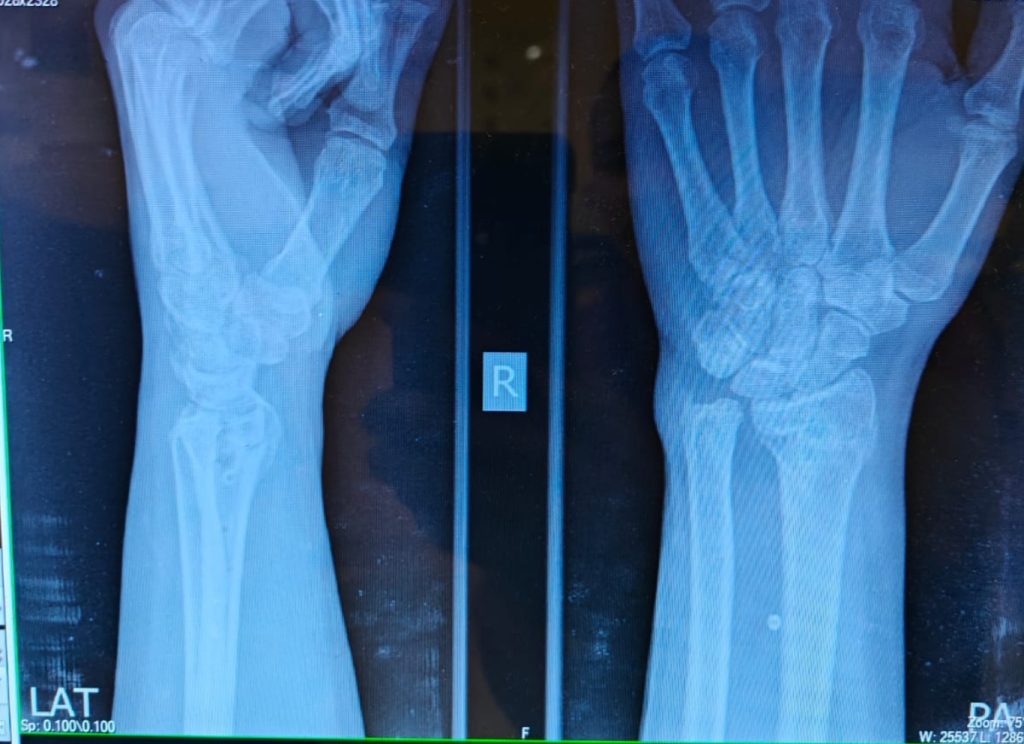
-Open wound over the ulnar aspect of the wrist/distal forearm
-Protrusion of both the radius and ulna through the wound
-Minimal gross contamination noted
-Severe tenderness and pain on attempted movement
-Palpable radial and ulna pulses
-No neurovascular compromises noted by preserved sensory and motor functions of median, ulnar and radial nerves.
-Capillary refill less than 3 seconds
Investigations
Radiology
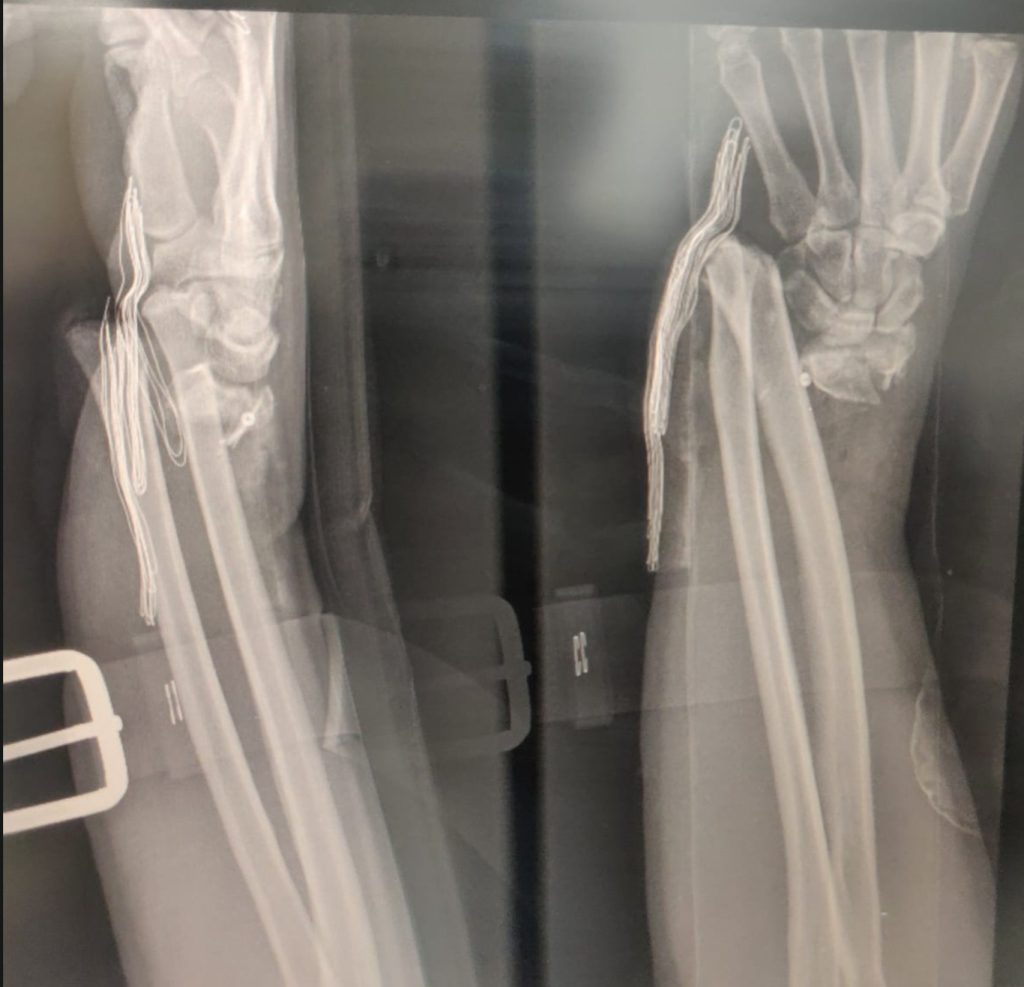
Right Forearem Both Bone distal radius and ulna metaphyseal fracture-dislocation
Treatment & Procedures
Initial Management:
Wound Irrigation with 0.9% Normal saline and layered wound dressing with wet-to-dry gauge and application of backslab and STAT doses do analgesics and antibiotics.
Operating Theater Management
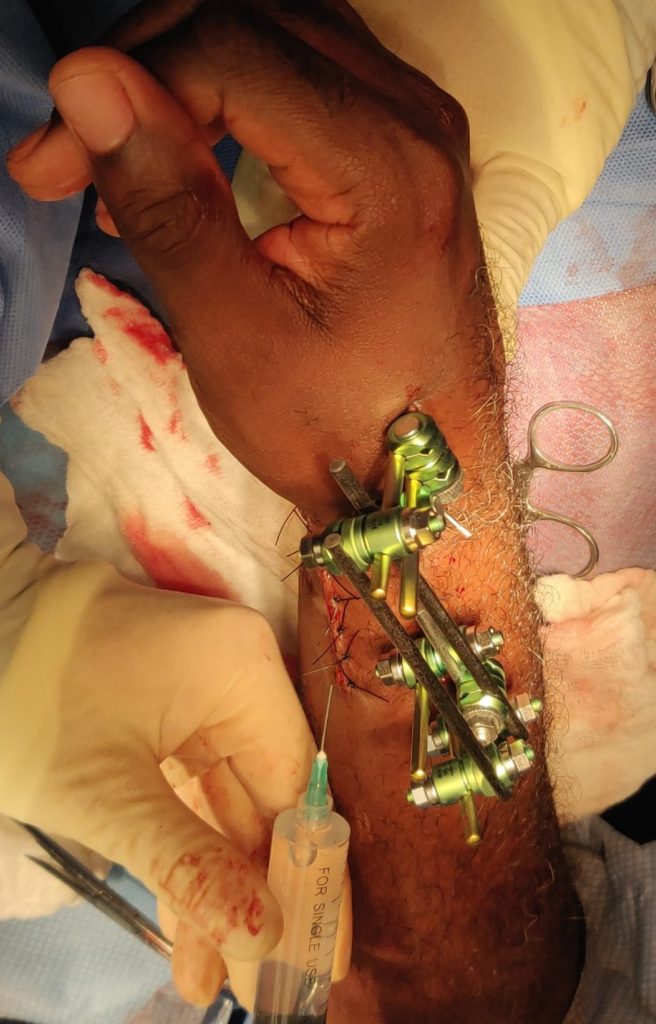
Given the open nature of the fracture and exposed bone, the patient was taken emergently to the operating theater where the following procedures were performed:
- Extensive wound irrigation
- Aggressive wound debridement
- Reduction of fracture fragments
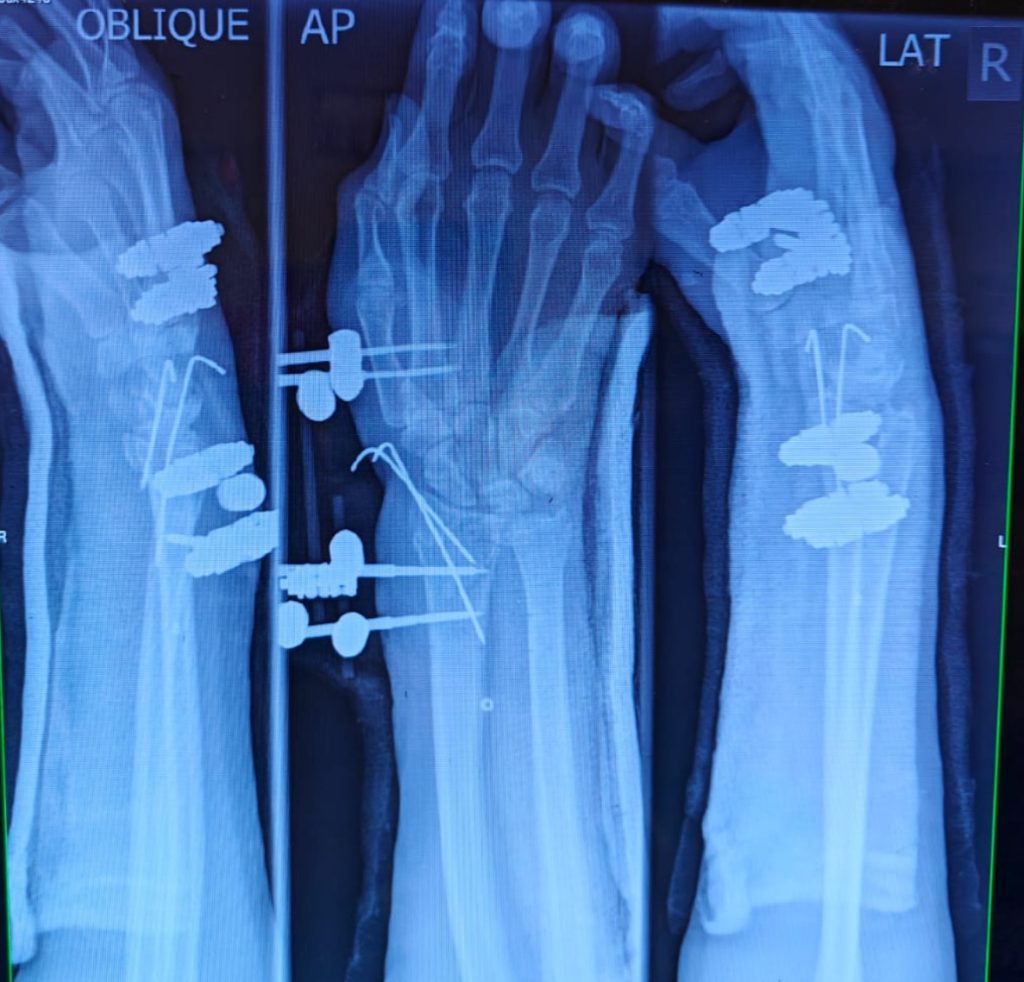
- Application of wrist-spanning external fixation
This reduces the risk of:
- Deep infection
- Osteomyelitis
- Soft tissue necrosis
- Neurovascular deterioration
- Malunion or nonunion
The external fixator was selected to:
- Restore length and alignment
- Maintain fracture stability
- Protect soft tissue integrity
- Allow ongoing wound surveillance and dressing care
Postoperative Course
The patient was admitted to the surgical ward for three days for:
- Neurovascular monitoring
- Intravenous antibiotics
- Analgesia
- Serial dressing changes
- Observation for compartment syndrome or infection
Figures
Self-Test Questions
1. What is the Gustilo-Anderson classification, and why is it important in open fractures?
Suggested Answer & Explanation:
The Gustilo-Anderson classification is a system used to categorize open fractures based on:
- Wound size
- Degree of contamination
- Soft tissue injury
- Fracture pattern
- Neurovascular involvement
This patient had a Gustilo-Anderson Type IIIA open fracture, characterized by:
- Wound >1 cm
- Moderate soft tissue injury
- Bone Exposure
- Minimal periosteal stripping
- Moderate contamination without extensive tissue loss
The classification is important because it helps guide:
- Antibiotic selection
- Surgical urgency
- Need for soft tissue reconstruction
- Prognosis
- Infection risk assessment
Higher-grade injuries are associated with increased rates of:
- Osteomyelitis
- Nonunion
- Neurovascular injury
- Amputation
What are the key principles in the emergency management of open fractures?
Suggested Answer & Explanation:
Initial management of open fractures follows several essential orthopedic trauma principles:
- ATLS assessment and stabilization
- Prompt intravenous antibiotics
- Tetanus prophylaxis
- Sterile saline irrigation and dressing
- Pain control
- Temporary immobilization
- Urgent orthopedic consultation
- Early operative debridement
In this case:
- The wound was irrigated
- Wet-to-dry dressing applied
- Backslab immobilization performed
- IV antibiotics and analgesia administered
- Patient was taken urgently to the operating theater
Early antibiotic administration is one of the most important factors in reducing infection risk.
Why was wrist-spanning external fixation chosen in this patient?
Suggested Answer & Explanation:
External fixation was selected because the patient had:
- An open fracture
- Soft tissue compromise
- Bone protrusion
- Need for ongoing wound access
Advantages of wrist-spanning external fixation include:
- Rapid stabilization
- Restoration of length and alignment
- Minimal additional soft tissue disruption
- Easy wound surveillance and dressing changes
- Reduced operative time in contaminated injuries
It also acts as a damage-control strategy in severe trauma while allowing staged management if needed.
What neurovascular structures must be assessed in distal forearm fractures?
Suggested Answer & Explanation:
A complete neurovascular examination is mandatory in distal forearm trauma.
Nerves to assess:
Median nerve
- Sensation: thumb, index, middle finger
- Motor: thumb opposition
Ulnar nerve
- Sensation: little finger
- Motor: finger abduction/adduction
Radial nerve
- Sensation: dorsal first web space
- Motor: wrist/thumb extension
Vascular assessment:
- Radial pulse
- Ulnar pulse
- Capillary refill
- Skin temperature and color
In this case:
- Radial and ulnar pulses were intact
- Capillary refill was <3 seconds
- Median, ulnar, and radial nerve functions were preserved
- No neurovascular compromise was identified
Serial examinations are essential because compartment syndrome or delayed neuropathy may develop later.
What are common complications following open distal radius and ulna fractures?
Suggested Answer & Explanation:
Complications may be early or late.
Early complications:
- Infection
- Osteomyelitis
- Compartment syndrome
- Neurovascular injury
- Soft tissue necrosis
Late complications:
- Malunion
- Nonunion
- Wrist stiffness
- Tendon adhesions
- Chronic pain
- Post-traumatic arthritis
- Carpal tunnel syndrome
In this patient:
- Mild wrist stiffness developed
- Intermittent paresthesia raised concern for carpal tunnel syndrome
- No progressive neurological deficit occurred
- Final outcome was excellent with functional recovery
Outcome and Case Discussion
Open fractures of the distal radius and ulna constitute orthopedic emergencies due to the high risk of infection, soft tissue compromise, neurovascular injury, and long-term functional impairment. Prompt recognition and appropriate surgical management are essential to optimize outcomes and preserve limb function. This case discusses the successful management of a Gustilo-Anderson type II open distal both-bone forearm fracture sustained following a hoverboard fall in a middle-aged male. Management included urgent irrigation and debridement, fracture reduction, wrist-spanning external fixation, serial neurovascular monitoring, and structured rehabilitation. Despite transient postoperative neuropathic symptoms and mild wrist stiffness, the patient achieved excellent functional recovery without long-term disability.
Summary of Learning Points
This case illustrates several important orthopedic principles:
- Early Surgical Debridement
Prompt irrigation and debridement remain foundational in open fracture management and significantly reduce infection risk.
- Damage Control Stabilization
External fixation provided rapid stabilization while preserving access to soft tissues and minimizing further operative trauma during the acute inflammatory phase.
- Importance of Neurovascular Monitoring
Despite severe skeletal injury and exposed bone, the patient maintained intact neurovascular status throughout treatment, contributing significantly to his favorable outcome.
- Rehabilitation and Functional Recovery
Prolonged immobilization across the wrist often results in postoperative stiffness. Early physiotherapy and patient compliance were central to recovery.
- Post-Traumatic Neuropathy Consideration
Transient paresthesia and concern for carpal tunnel syndrome are recognized sequelae following distal forearm trauma and external fixation. Conservative management was appropriate in this patient due to limited symptoms and preserved function.
References
American Academy of Orthopaedic Surgeons. Court-Brown CM, Heckman JD, McQueen MM, Ricci WM, Tornetta P, McKee MD. Rockwood and Green’s Fractures in Adults. 9th ed. Philadelphia: Wolters Kluwer; 2020.
Gustilo RB, Anderson JT. Prevention of infection in the treatment of one thousand and twenty-five open fractures of long bones: retrospective and prospective analyses. J Bone Joint Surg Am. 1976;58(4):453–458.
Gustilo RB, Mendoza RM, Williams DN. Problems in the management of type III severe open fractures. Clin Orthop Relat Res. 1984;(178):84–95.
Orthopaedic Trauma Association. Hauser CJ, Adams CA Jr, Eachempati SR. Surgical Infection Society guideline: prophylactic antibiotic use in open fractures. Surg Infect (Larchmt). 2006;7(4):379–405.
Pollak AN, Jones AL, Castillo RC, Bosse MJ, MacKenzie EJ. The relationship between time to surgical debridement and incidence of infection after open high-energy lower extremity trauma. J Bone Joint Surg Am. 2010;92(1):7–15.
AO Foundation. Rüedi TP, Buckley RE, Moran CG. AO Principles of Fracture Management. 3rd ed. Stuttgart: Thieme; 2018.
Jupiter JB, Fernandez DL, Toh CL, et al. Operative treatment of volar intra-articular fractures of the distal end of the radius. J Bone Joint Surg Am. 1996;78(12):1817–1828.
Trampuz A, Zimmerli W. Diagnosis and treatment of infections associated with fracture-fixation devices. Injury. 2006;37 Suppl 2:S59–S66.
Court-Brown CM, Caesar B. Epidemiology of adult fractures: a review. Injury. 2006;37(8):691–697.
British Orthopaedic Association. BOAST Guidelines for Open Fractures. British Orthopaedic Association Standards for Trauma; updated guidelines.

Comments and Inquiries
No comments yet. Be the first to ask a question or leave a comment.