

A Case of Spontaneous Knee Pain in a Middle Aged Patient
Case Details
Relevant Clinical History
A 67-year-old female presented to her GP with a sudden, non-traumatic onset of right knee pain, associated with difficulty weight-bearing. She had previously been fit and well, with no history of knee symptoms or prior knee surgery. There were no symptoms affecting other systems, and she appeared systemically well at presentation.
Clinical Examination
On Examination:
The patient was unable to weight bear in the clinic. The extensor mechanism was intact, with good range of motion and a stable knee joint. Despite this, she exhibited marked tenderness diffusely around the knee, with no external signs of trauma.
Examination of the hips and spine was normal, with no evidence of referred pain or proximal pathology.
Investigations
-
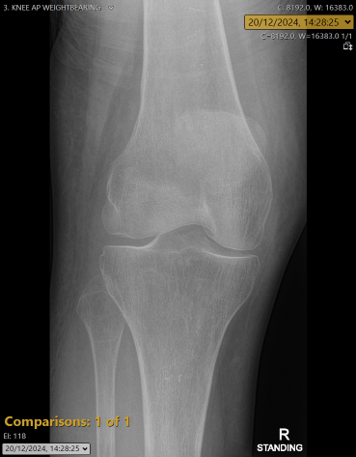
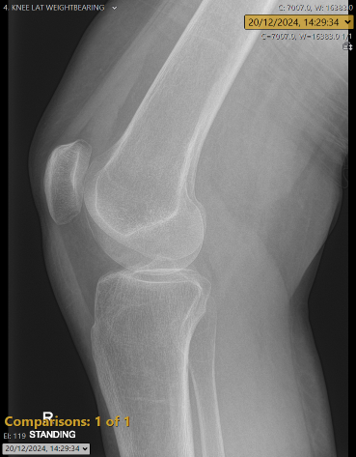
Initial AP and lateral radiographs of the right knee were obtained.
-
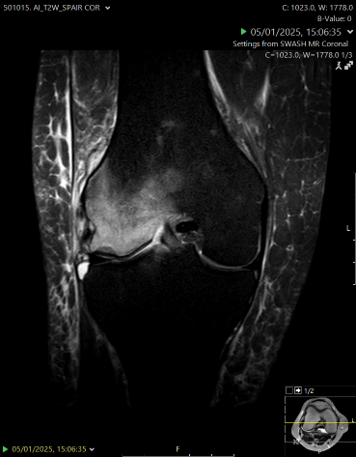
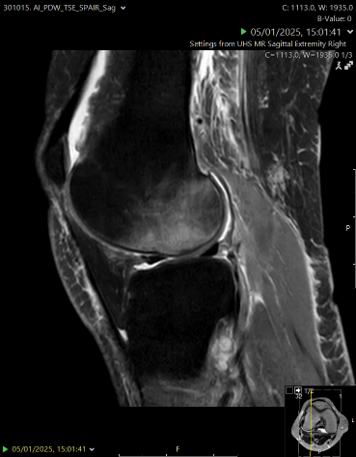
An MRI scan was subsequently performed, including coronal and sagittal T2-weighted sequences.
Treatment & Procedures
-
Pain management with appropriate analgesia
-
Off-loading of the limb, with non–weight bearing as tolerated
-
Use of a range-of-motion (ROM) brace to support the knee while allowing controlled movement
-
Early physiotherapy and guided rehabilitation exercises to maintain mobility and prevent stiffness
-
Surgery is generally not indicated, as most cases respond well to conservative management
Figures
Self-Test Questions
Describe your approach to examining this patient.
Suggested Answer & Explanation:
Knee Examination:
A comprehensive knee assessment was performed, examining for swelling (effusion), scars, erythema, deformity, lumps, gait pattern, and any varus or valgus malalignment on inspection. Stability tests, range of motion (ROM), and palpation for tenderness or crepitus were carried out.
The patient demonstrated marked global tenderness around the knee, particularly over the distal femoral region, with no additional abnormal findings.
Hip and Spine Examination:
A full assessment of the hips and lumbar spine revealed normal findings, with no evidence of referred pain.
What differential diagnoses would you consider in this case?
Suggested Answer & Explanation:
-
Osteoarthritis
-
Inflammatory arthritis (e.g., rheumatoid arthritis)
-
Undisplaced or occult fracture of the distal femur or tibial plateau
-
Septic arthritis
-
Meniscal pathology or other soft-tissue intra-articular injury
-
Soft-tissue tumour around the knee
-
Ruptured Baker’s (popliteal) cyst
-
Spontaneous Osteonecrosis of the Knee (SONK) — Final Diagnosis
What additional investigations would you request, and why?
Suggested Answer & Explanation:
-
Blood tests, including FBC, ESR, and CRP, to assess for infection or inflammatory activity
-
Screening for inflammatory arthropathies (e.g., rheumatoid factor, anti-CCP, ANA)
-
CT scan, if further bony detail is required or MRI is not immediately available
-
MRI scan, which is the gold standard for diagnosing conditions such as SONK, occult fractures, bone marrow oedema, and soft-tissue pathology
Outline your management plan for this patient.
Suggested Answer & Explanation:
The initial management of Spontaneous Osteonecrosis of the Knee (SONK) is predominantly conservative, particularly in early or moderate stages.
Conservative Measures:
-
Analgesia and NSAIDs for pain control
-
Bisphosphonates, which may help limit progression by reducing bone resorption
-
Off-loading of the knee with a period of non–weight bearing or partial weight bearing
-
Use of a range-of-motion (ROM) brace for support
-
Early physiotherapy and ROM exercises to maintain mobility and prevent stiffness
Surgical Management:
Surgery is generally reserved for persistent or recalcitrant cases that fail conservative therapy or show radiological progression. Options include:
-
Arthroscopic debridement
-
Core decompression
-
Microfracture
-
Osteochondral grafting (autograft or allograft)
What are the Learning Points/What should you be aware of?
Suggested Answer & Explanation:
-
SONK commonly affects middle-aged patients and should be considered in this age group presenting with acute knee pain.
-
It is typically not associated with trauma, making the diagnosis easy to overlook.
-
The onset of pain is sudden and spontaneous, often severe and disproportionate to initial findings.
-
Maintain a very high index of suspicion, especially when the severity of pain exceeds the radiographic appearance on initial X-rays.
-
Further imaging, particularly MRI, is essential to confirm the diagnosis and assess the extent of osteonecrosis.
-
Consider supportive investigations such as inflammatory markers to exclude other causes (e.g., inflammatory arthropathy).
-
Management is supportive, requiring off-loading, analgesia, and physiotherapy, with a prolonged period of follow-up to monitor progression or resolution.
Outcome and Case Discussion
Spontaneous osteonecrosis of the knee (SONK) most commonly affects the subchondral bone of the medial femoral condyle, which bears the highest load during weight-bearing activities. Involvement of the lateral femoral condyle or tibial plateau is far less frequent. SONK is characterised by crescent-shaped subchondral lesions, typically presenting with sudden, severe knee pain, swelling, functional limitation, and a risk of progressive joint deterioration.
It predominantly affects individuals over the age of 55, suggesting a relationship with postmenopausal osteoporosis and underlying bone insufficiency.
Aetiology and Pathogenesis
The exact cause of SONK remains uncertain due to its multifactorial nature, but several theories have been proposed:
-
Subchondral insufficiency fractures in osteoporotic bone leading to compromised vascularity
-
Venous congestion resulting in impaired subchondral circulation
-
Localized trauma or repetitive microtrauma, even in the absence of a clear injury
Although the clinical presentation is often nonspecific, these mechanisms contribute to the development of subchondral collapse and secondary osteoarthritis if untreated.
Diagnosis
Diagnosis relies on a combination of clinical assessment and advanced imaging:
-
MRI is the gold standard, detecting early marrow oedema and defining lesion size, location, and stage.
-
Plain radiographs may be normal in the early phase, but in later stages can show:
-
Subchondral sclerosis
-
Crescent sign or collapse
-
Flattening of the femoral condyle
-
Progressive joint space narrowing
Diagnostic work-up should also include investigations to exclude alternative causes of acute knee pain, such as inflammatory arthropathy or infection.
-
Management
Management of SONK is individualised, depending on the size of the lesion, disease stage, symptom severity, and the patient’s overall health.
Nonoperative Management (Early / Small Lesions)
-
Analgesia and NSAIDs
-
Bisphosphonates to reduce bone resorption
-
Off-loading or non–weight bearing
-
ROM bracing
-
Physiotherapy and early mobilisation
Small lesions often stabilise or regress with conservative treatment.
Operative Management (Advanced / Larger Lesions or Failed Conservative Care)
When symptoms persist or imaging shows progression, surgical options include:
-
Arthroscopic debridement
-
Core decompression
-
Microfracture
-
Osteochondral grafting (autograft or allograft)
In post-collapse disease, total knee arthroplasty becomes an appropriate and definitive solution.
Summary of Learning Points
-
The diagnosis of SONK requires a high index of suspicion.
-
Careful, attentive history-taking is essential – the patient’s description of pain and function often provides the key clue.
-
If symptoms do not correlate with the initial X-rays, always consider further imaging or investigations (e.g. MRI).
-
A “normal” knee X-ray does not necessarily mean a normal knee – occult pathology such as SONK may still be present.
References
1. Daniel Li; Alan G. Shamrock; Joseph R. Young; Andrew J. Rosenbaum, Treasure Island (FL): StatPearls Publishing; 2025 Jan-.
2. Ahlbäck S, Bauer GC, Bohne WH. Spontaneous osteonecrosis of the knee. Arthritis Rheum. 1968 Dec;11(6):705-33. [PubMed]
3. Mont MA, Marker DR, Zywiel MG, Carrino JA. Osteonecrosis of the knee and related conditions. J Am Acad Orthop Surg. 2011 Aug;19(8):482-94. [PubMed]
4. Juréus J, Lindstrand A, Geijer M, Robertsson O, Tägil M. The natural course of spontaneous osteonecrosis of the knee (SPONK): a 1- to 27-year follow-up of 40 patients. Acta Orthop. 2013 Aug;84(4):410-4. [PMC free article] [PubMed]
5. Mont MA, Baumgarten KM, Rifai A, Bluemke DA, Jones LC, Hungerford DS. Atraumatic osteonecrosis of the knee. J Bone Joint Surg Am. 2000 Sep;82(9):1279-90. [PubMed]
6. Zaremski JL, Vincent KR. Spontaneous Osteonecrosis of the Knee. Curr Sports Med Rep. 2016 Jul-Aug;15(4):228-9. [PubMed]
7. Lotke PA, Ecker ML. Osteonecrosis of the knee. Orthop Clin North Am. 1985 Oct;16(4):797-808. [PubMed]
8. Yasuda T, Ota S, Fujita S, Onishi E, Iwaki K, Yamamoto H. Association between medial meniscus extrusion and spontaneous osteonecrosis of the knee. Int J Rheum Dis. 2018 Dec;21(12):2104-2111. [PubMed]
9. Ecker ML, Lotke PA. Spontaneous Osteonecrosis of the Knee. J Am Acad Orthop Surg. 1994 May;2(3):173-178. [PubMed]
10. Jones JP. Alcoholism, hypercortisonism, fat embolism and osseous avascular necrosis. 1971. Clin Orthop Relat Res. 2001 Dec;(393):4-12. [PubMed]
11.Yamamoto T, Bullough PG. Spontaneous osteonecrosis of the knee: the result of subchondral insufficiency fracture. J Bone Joint Surg Am. 2000 Jun;82(6):858-66. [PubMed]

Comments and Inquiries
No comments yet. Be the first to ask a question or leave a comment.