

A Diagnostic Challenge and Inability to Weight-Bear After a Fall
Case Details
Relevant Clinical History
First Visit:
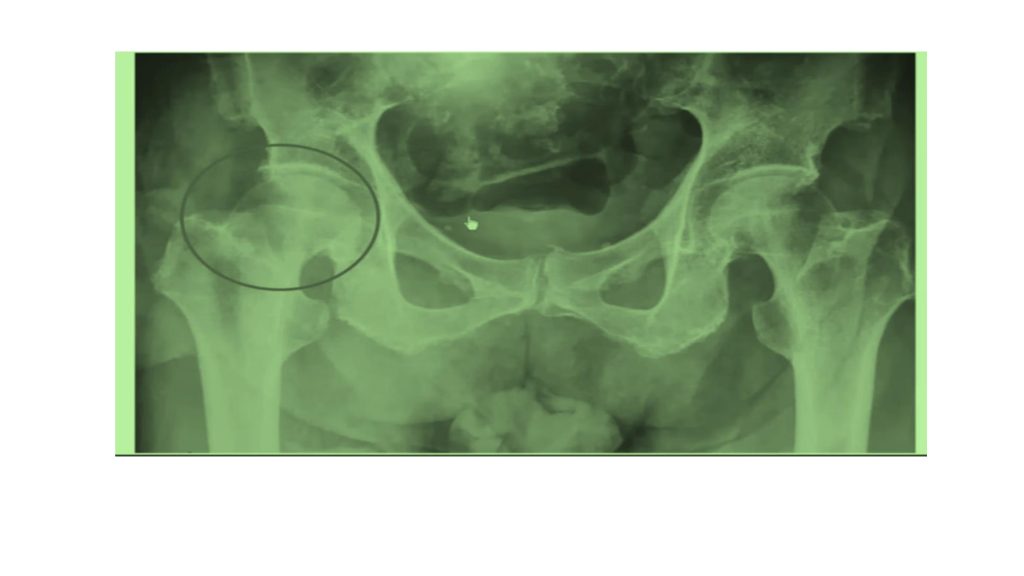
A 79-year-old patient presented from a care home following an unwitnessed fall, reporting mild right hip pain and walking with a limp. Past medical history includes hypertension, type 2 diabetes, COPD, and atrial fibrillation on warfarin. Hip X-rays were performed during this initial assessment.
Second Visit:
The patient returned with no history of a new fall, but with significantly increased right lower limb pain and inability to mobilise for the past 48 hours.
Clinical Examination
First Visit:
Examination showed mild tenderness over the right greater trochanteric region. The rolling test was not performed, and the patient was able to perform a straight leg raise, though with mild discomfort on the right side.
There were minimal bruises over the trochanteric area, with no deformity and no leg-length discrepancy.
Second Visit:
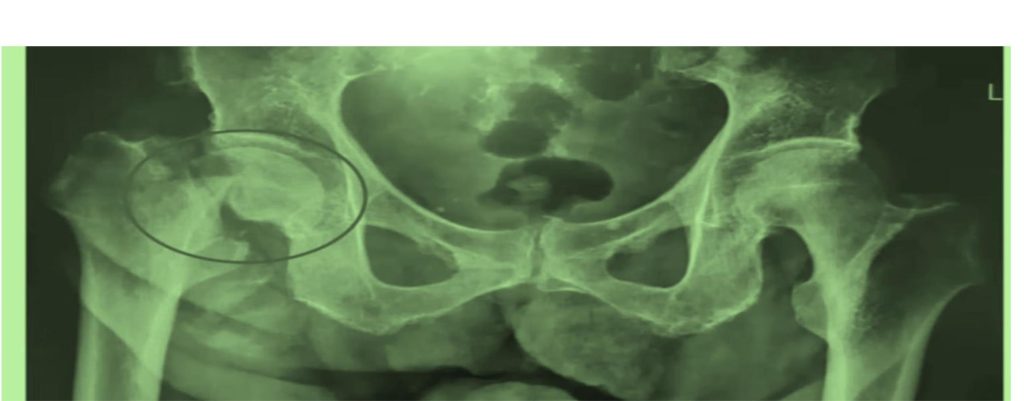
The patient returned with the right lower limb held in external rotation, with shortening and significant pain consistent with a possible displaced hip fracture.
Investigations
First Visit X-ray:
No significant fracture was identified.
Second Visit X-ray:
A displaced right femoral neck fracture was confirmed.
Treatment & Procedures
First Visit:
The patient was discharged after the initial assessment with PRN analgesia.
Second Visit:
The patient was admitted with a diagnosis of a displaced right femoral neck fracture and managed according to Blue Book guidelines, undergoing a cemented Unipolar (Unitrax) hemiarthroplasty.
Figures
Self-Test Questions
What clinical assessment findings at the initial visit should have prompted further imaging?
Suggested Answer & Explanation:
Key Clinical Findings That Should Prompt Further Imaging at the Initial Visit
-
Clear and focused palpation of the hip joint to identify deep tenderness suggestive of an occult fracture.
-
Rolling (log-roll) test to assess for pain with minimal hip rotation — a highly sensitive indicator of intracapsular hip fracture.
-
Painful or incomplete Straight Leg Raise (SLR), or inability to perform SLR, which may indicate underlying hip pathology despite normal initial X-ray findings.
What further imaging would you consider if CT or MRI are not available?
Suggested Answer & Explanation:
Hip X-ray in Internal Rotation
Obtaining an AP hip X-ray in internal rotation helps profile the femoral neck more clearly, reducing overlap of the greater trochanter and improving visualisation of subtle fractures.
AP View – What to Look For
-
Discontinuity or step-off at the superolateral femoral head–neck junction
-
Subtle cortical breaks or irregularity
-
Trabecular disruption, which may be the only early clue in an impacted or occult fracture
-
Careful comparison with the opposite hip for asymmetry in trabecular alignment, density, or architecture
These subtle signs are easy to miss, especially in early or minimally displaced fractures.
Lateral View – Key Features
-
Loss of normal femoral anteversion, suggesting rotational deformity at the fracture site
-
Opening or disruption of the anterior cortex, indicating displacement or instability
-
Posterior cortical comminution, when visible, which has major implications for fixation stability and may influence the choice between fixation and arthroplasty
When to Perform a CT Scan in Suspected Hip Fractures
Suggested Answer & Explanation:
Indications for CT Scan in Suspected Hip Fractures
A CT scan is appropriate in the following situations:
-
Suspected nondisplaced (occult) femoral neck fractures when plain X-rays are normal or equivocal
-
To differentiate displaced from undisplaced fractures, especially when subtle cortical irregularities are present
-
To assess posterior cortical comminution, which has important implications for fixation stability and surgical planning
-
When MRI is contraindicated, such as in patients with:
-
Pacemakers or incompatible cardiac devices
-
Severe claustrophobia
-
Metallic foreign bodies
-
Other MRI-incompatible implants
-
When to Perform an MRI in Suspected Hip Fractures
Suggested Answer & Explanation:
Indications for MRI in Suspected Hip Fractures
-
Early detection of occult or nondisplaced fractures, especially when X-rays are normal but clinical suspicion remains high
-
Assessment of atypical presentations, where MRI helps differentiate between neoplasia, avascular necrosis (AVN), stress injury, or soft-tissue pathology
-
MRI is the gold standard for identifying occult hip fractures and marrow oedema patterns that are not visible on plain radiographs or CT
Outcome and Case Discussion
The patient ultimately underwent a right hemiarthroplasty (Unitrax Exeter) for a displaced femoral neck fracture, which had likely been present but missed as an undisplaced fracture during the initial visit.
Summary of Learning Points
-
Ensure optimal clinical examination, including targeted hip tests such as log-roll and assessment for pain on SLR.
-
Be aware that patients with low AMTS or cognitive impairment may provide unreliable histories and have limited ability to describe or localise pain, making assessment more challenging.
-
Maintain a low threshold for further imaging when suspicion remains high despite normal initial X-rays.
-
Use additional imaging modalities such as CT or MRI to identify occult or nondisplaced fractures.
-
Remember the value of the internal rotation AP hip view, which improves visualisation of subtle femoral neck fractures.
References
Pinto A, Berritto D, Russo A. Traumatic fractures in adults: missed diagnosis on plain radiographs in the Emergency Department. Acta Biomed. 2018;89(Suppl 1):111–123.

Comments and Inquiries
No comments yet. Be the first to ask a question or leave a comment.